Industrial air compressors are critical to production continuity, equipment performance, air quality, and overall operational stability.
When a compressed air system fails, the impact is rarely limited to the compressor itself. Production lines may slow down, pneumatic tools may lose performance, moisture may appear downstream, and energy consumption may rise without an obvious reason.
Preventive maintenance helps facilities avoid these problems by turning compressor care into a structured routine. It combines daily checks, scheduled inspections, performance monitoring, and clear escalation points when something does not look, sound, or operate as expected.
This guide explains how to perform preventive maintenance for industrial air compressors correctly, what to check, what “normal” looks like, which warning signs require attention, and when professional inspection or service is recommended.
Although this guide focuses on the industrial air compressor itself, compressor performance is also affected by nearby system components such as filters, drains, air dryers, and distribution leaks. For that reason, effective preventive maintenance should include basic checks around the compressor environment, especially where these components directly affect pressure stability, moisture control, and operating efficiency.
What Is Preventive Maintenance for Industrial Air Compressors
Preventive maintenance is a planned set of inspection, cleaning, monitoring, and service activities designed to keep industrial air compressors operating safely and efficiently.
Instead of waiting for breakdowns, preventive maintenance focuses on early detection. The goal is to identify changes in pressure, oil condition, moisture levels, air quality, temperature, vibration, and component wear before they develop into serious faults.
For industrial facilities, preventive maintenance helps:
- Reduce unexpected downtime
- Extend compressor lifespan
- Maintain consistent compressed air quality
- Improve energy efficiency
- Reduce emergency repair risk
- Support safer operation
- Create better documentation for future diagnostics
A good preventive maintenance program does not rely on guesswork. It uses routine checks, operating trends, and clear decision criteria.
Why Preventive Maintenance Matters in Industrial Facilities
Compressed air is often treated as a basic utility, but it is one of the most important systems in many industrial plants. Small problems, such as clogged filters, moisture carryover, leaks, unstable pressure, or abnormal oil condition, can create significant operational consequences over time.
A poorly maintained compressor may still run, but it may run harder than necessary. This can increase energy use, accelerate component wear, reduce air quality, and increase the risk of unplanned downtime.
Preventive maintenance matters because it helps facility teams recognize early signs of degradation, including:
- Gradual pressure instability
- Rising operating temperature
- Increased compressor load
- Frequent alarms or resets
- Poor air quality downstream
- Moisture or oil carryover
- Unusual sound or vibration
The earlier these signs are detected, the easier it is to correct them before they become disruptive.
Practical Preventive Maintenance Checklist
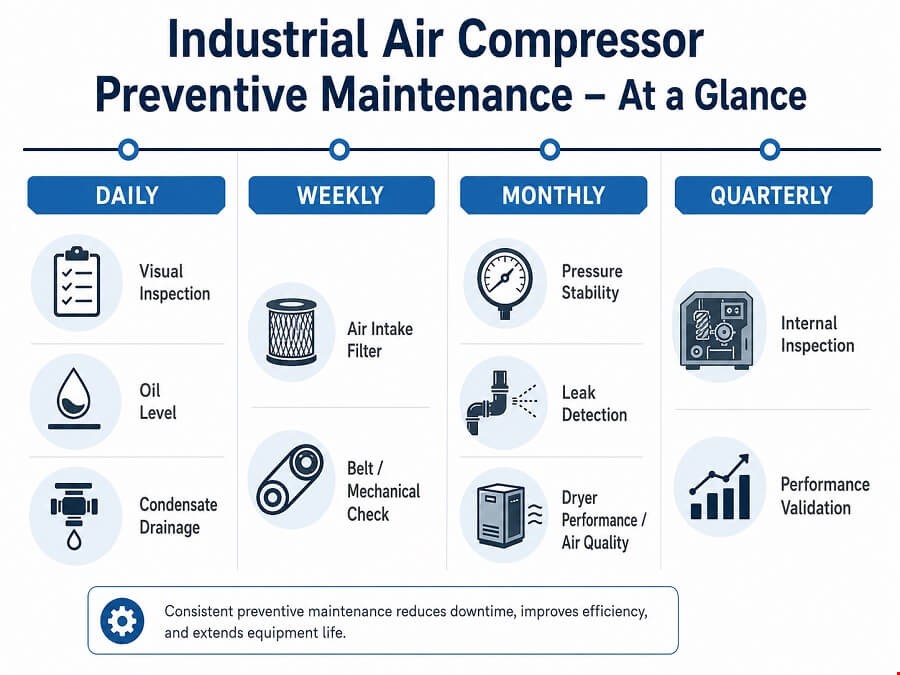
The checklist below summarizes the core preventive maintenance tasks for industrial air compressors. It is designed as a practical reference for facility teams and maintenance personnel. Each task includes the recommended frequency, what normal operation looks like, warning signs to watch for, and the action required when conditions are not normal.
Preventive Maintenance Checklist for Industrial Air Compressors
On mobile: ↔ Scroll horizontally to view full table
| Task Category |
Maintenance Task |
Frequency |
Responsible |
What Normal Looks Like |
Warning Signs |
Action Required |
| Visual |
General inspection |
Daily |
Operator |
Clean surfaces, stable operation, no visible leaks. |
Oil stains, loose fittings, abnormal vibration. |
Clean and re-check; escalate if it persists. |
| Lubrication |
Oil level and condition |
Daily |
Maintenance |
Level within range; oil looks clear/light. |
Low level, dark, milky or foamy oil, frequent top-ups. |
Top up only if approved; schedule inspection if abnormal. |
| Moisture |
Drain condensate |
Daily |
Operator |
Clear water; consistent daily volume. |
Oily condensate, irregular volume, blocked drains, water downstream. |
Check drains and dryer performance; inspect if recurring. |
| Filtration |
Air intake filter check |
Weekly |
Maintenance |
Light dust; no performance change. |
Heavy clogging, rising temperature, reduced airflow. |
Clean or replace filter; verify airflow. |
| Mechanical |
Belt condition and tension |
Weekly |
Maintenance |
Even tension; no cracking or fraying. |
Slipping noise, cracks, uneven wear, frequent retensioning. |
Adjust per specification or replace belt. |
| System |
Pressure stability observation |
Monthly |
Maintenance |
Stable pressure; smooth load and unload behavior. |
Fluctuations, frequent cycling, delayed response. |
Leak survey and diagnostics; inspect if unresolved. |
| Air Quality |
Dryer performance check |
Monthly |
Maintenance |
Dry air at point of use; stable dew point. |
Moisture in lines, unstable dew point, corrosion or water accumulation. |
Service dryer and filtration; verify air quality. |
| Internal |
Internal component inspection and validation |
Quarterly |
Service |
Normal wear; documented findings. |
Oil carryover, recurring faults, abnormal wear patterns. |
Schedule preventive maintenance inspection. |
Download the printable PDF version of this preventive maintenance checklist here >>
How to Use the Checklist Correctly
The checklist should not be treated as a one-time reference. It should become part of the facility’s maintenance routine.
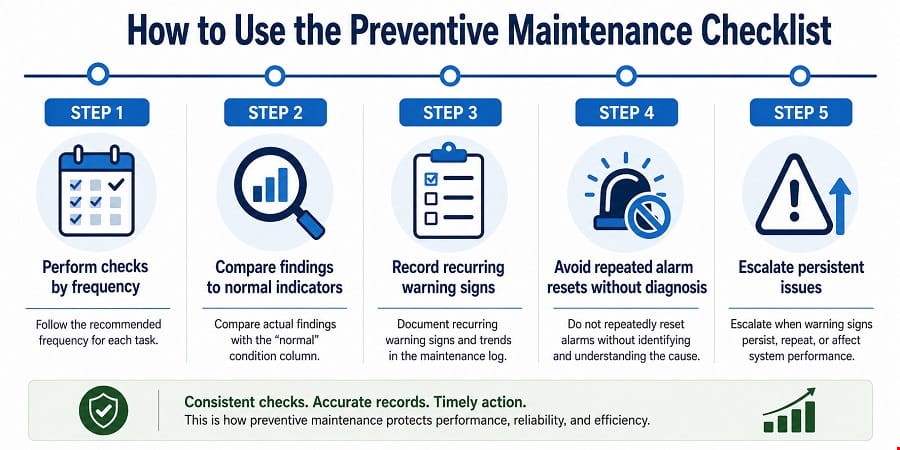
To use it effectively:
- Perform the checks according to the recommended frequency.
- Compare actual findings with the “normal” condition column.
- Record recurring warning signs in the maintenance log.
- Do not repeatedly reset alarms without understanding the cause.
- Escalate when warning signs persist, repeat, or affect system performance.
A checklist is most valuable when it supports consistent decision-making. If the same warning sign appears more than once, it should be treated as a pattern, not an isolated event.
How Often Should Preventive Maintenance Be Performed?
There is no single maintenance schedule that fits every industrial compressor. The right frequency depends on operating conditions, system configuration, and manufacturer recommendations.
Key factors include:
- Daily operating hours
- Duty cycle and load profile
- Ambient temperature
- Dust, humidity, and ventilation conditions
- Compressor type and lubrication system
- Air quality requirements
- Production criticality
- Age and service history of the compressor
As a general framework, most facilities should organize maintenance into four levels
- Daily checks: basic visual and operational checks
- Weekly checks: filters, belts, mechanical condition, and basic leak review
- Monthly checks: pressure stability, air quality, leak detection, dryer performance
- Quarterly or periodic service: internal inspections, component evaluation, and professional validation
Facilities operating in harsh environments, high-load conditions, or critical production settings may require shorter intervals.
Daily Preventive Maintenance Checks
Daily checks are the foundation of compressor reliability. They are usually simple, but they are also the first opportunity to detect problems before they grow.
Visual Inspection
What to do:
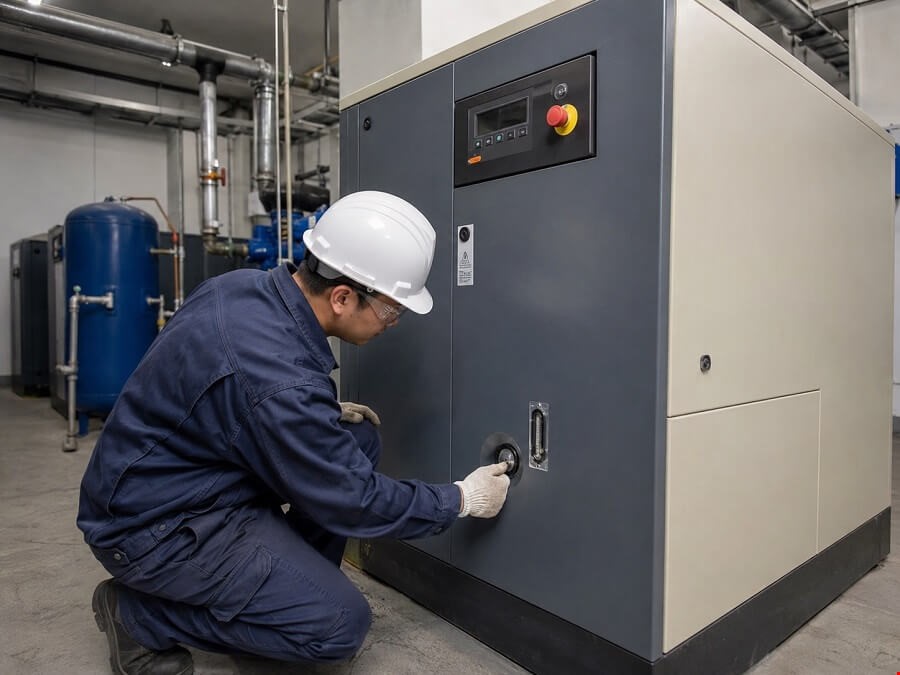
Walk around the compressor and connected equipment before startup and during normal operation. Look at the compressor, receiver, filters, hoses, fittings, drains, and surrounding area.
What normal looks like:
- Clean surfaces with light operational residue
- Stable operation
- No visible oil stains
- No loose fittings or hoses
- No abnormal movement
Warning signs:
- Oil pooling or wet surfaces
- Dust accumulation around the air intake
- Loose hoses or fittings
- Visible vibration during operation
- Unusual dirt or residue around components
Action required:
Clean the area, re-check the condition, and monitor whether the issue returns. If leaks, vibration, or visible damage persist, further inspection is recommended.
Oil Level and Condition
What to do:
Check oil level using the sight glass or dipstick according to the compressor manufacturer’s instructions. Oil checks should be performed when the machine condition matches the recommended checking procedure.
What normal looks like:
- Oil level within the marked operating range
- Oil appears clear or lightly colored
- No foam or milky appearance
- No rapid drop between checks
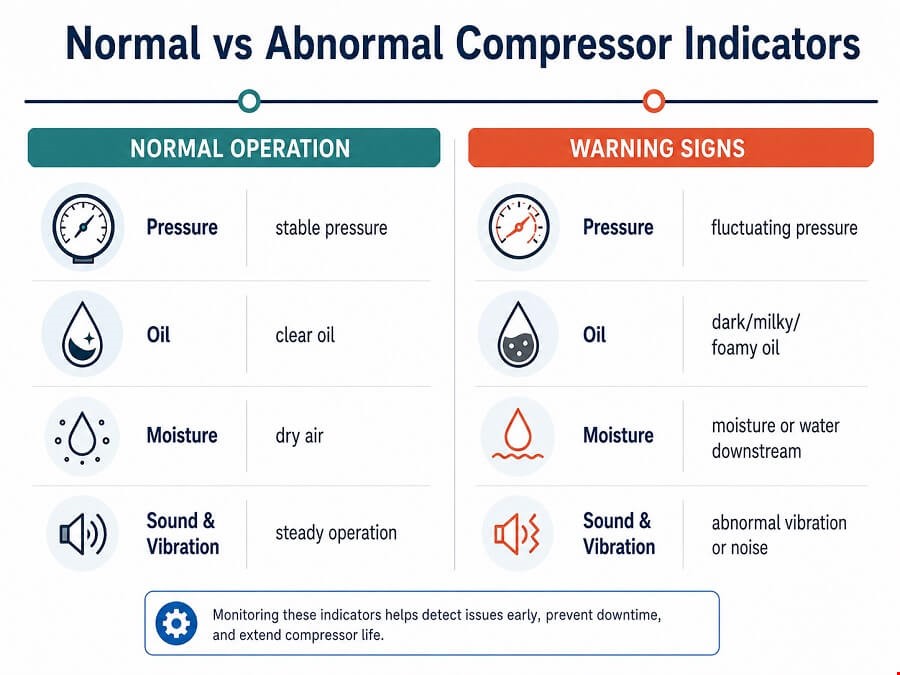
Warning signs:
- Oil below the minimum level
- Dark, milky, or foamy oil
- Burnt smell
- Frequent need for topping up
- Sudden change in oil appearance
Action required:
Do not ignore changes in oil condition. Low or degraded oil may indicate leaks, overheating, contamination, or internal wear. Top up only if approved by the operating procedure, and schedule inspection if abnormal oil condition persists.
Condensate Drainage
What to do:
Drain condensate from receivers, separators, filters, and relevant drainage points. Automatic drains should also be checked to make sure they are functioning correctly.
What normal looks like:
- Clear water or lightly contaminated condensate
- Consistent daily volume
- No water accumulation downstream
- Drain points operate as expected
Warning signs:
- Oily condensate
- Irregular drainage volume
- Blocked or inactive drains
- Water appearing downstream in air lines
- Moisture reaching pneumatic equipment or production points
Action required:
Check drains and air dryer performance. Persistent moisture issues often indicate a dryer, filtration, or drainage problem that requires further inspection. Air filtration and draining of liquids products >>
Weekly Compressor Maintenance Tasks
Weekly maintenance focuses on components that are exposed to dust, airflow restrictions, mechanical wear, and operating load.
Air Intake Filter Check
What to do:
Inspect the air intake filter for dust, clogging, and contamination. If the environment is dusty, filter checks may need to be performed more frequently.
What normal looks like:
- Light dust accumulation
- No visible blockage
- Stable compressor temperature
- No pressure or airflow symptoms linked to intake restriction
Warning signs:
- Heavy contamination
- Rising operating temperature
- Reduced airflow
- Increased compressor load
- Pressure drop across the system
Action required:
Clean or replace the filter according to manufacturer guidance. A clogged intake filter forces the compressor to work harder, which can increase energy consumption and mechanical wear.
Belt Condition and Mechanical Drive Components
What to do:
Inspect belts and drive components for tension, alignment, cracks, fraying, and uneven wear. Listen for slipping or squealing sounds during operation.
What normal looks like:
- Even belt tension
- No cracking or fraying
- No slipping noise
- No visible misalignment
- No frequent need for retensioning
Warning signs:
- Slipping sounds
- Cracks or frayed belt edges
- Uneven wear
- Frequent retensioning required
- Excessive heat around drive components
Action required:
Adjust according to specification or replace the belt when wear is visible. Mechanical wear at this stage often precedes larger failures.
Monthly System Performance Checks
Monthly System Performance ChecksMonthly checks help identify performance issues that may not be obvious during daily operation.
Pressure Stability
What to do:
Observe pressure behavior during steady operation, load changes, and normal demand cycles. Watch how the compressor loads, unloads, and responds to air demand.
What normal looks like:
- Stable pressure within the defined operating range
- Smooth load and unload behavior
- Predictable response to demand changes
- No unusual delay in pressure recovery
Warning signs:
- Pressure fluctuations
- Frequent cycling
- Delayed response to demand changes
- Pressure decay during low demand
- System struggling to maintain target pressure
Action required:
Pressure instability can indicate leaks, control issues, valve wear, insufficient capacity, or changes in demand. Start with leak detection and basic diagnostics. If the issue continues, professional inspection is recommended.
Leak Detection
What to do:
Conduct leak surveys using ultrasonic tools, systematic listening checks, or scheduled inspections during low-production periods. Pay attention to fittings, hoses, valves, couplings, filters, and distribution lines.
What normal looks like:
- Minimal audible leakage
- Stable system pressure during idle periods
- No unexplained compressor cycling when demand is low
Warning signs:
- Audible leaks
- Pressure decay during non-production hours
- Compressor cycling when equipment is not in use
- Air loss near fittings, valves, or hoses
Action required:
Repair leaks promptly and re-check system pressure after repair. Compressed air leaks are one of the most common hidden causes of energy waste in industrial facilities.
Air Dryer Performance
What to do:
Monitor moisture levels downstream of the dryer and at critical points of use. If dew point monitoring is available, review trends rather than relying on a single reading.
What normal looks like:
- Dry air at point of use
- Stable dew point
- No visible water in air lines
- No corrosion related to moisture
- No product quality issues linked to air humidity
Warning signs:
- Moisture in air lines
- Unstable dew point
- Corrosion or water accumulation
- Water reaching pneumatic tools
- Product quality issues related to compressed air moisture
Action required:
Check dryer operation, drains, filters, and downstream moisture indicators. Persistent moisture usually requires dryer service, filtration review, or system-level inspection.
Quarterly and Periodic Maintenance
As maintenance intervals extend, inspection work becomes more technical. Quarterly and periodic maintenance should go beyond surface-level checks and evaluate internal condition, performance trends, and component reliability.
Typical tasks include:
- Internal component inspection
- Oil separator evaluation
- Valve performance testing
- Control system review
- Safety device validation
- Performance verification under operating conditions
These tasks require appropriate expertise and should not be improvised. Internal components can degrade before symptoms become obvious to operators.
Warning signs that require escalation include:
- Oil carryover
- Recurrent fault codes
- Abnormal wear patterns
- Rising energy consumption without increased production demand
- Repeated pressure instability
- Moisture issues that return after basic checks
What Does a Professional Preventive Maintenance Visit Usually Include?
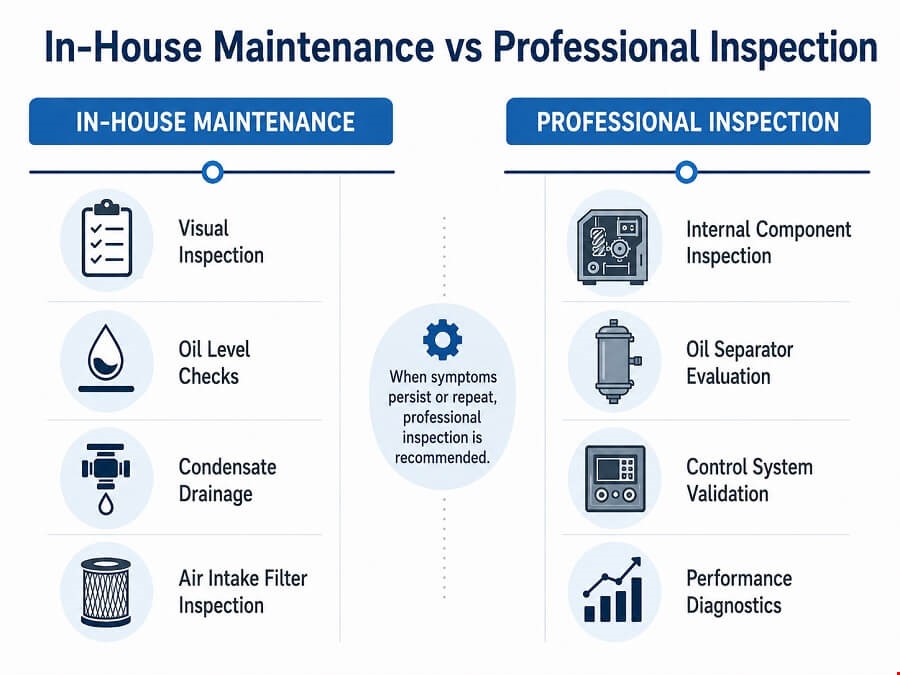
A professional preventive maintenance visit usually goes beyond basic visual checks. It may include structured inspection of compressor condition, oil and filter replacement where required, air treatment review, control and safety checks, performance testing, component adjustment, and documentation of findings.
For facilities with annual or periodic maintenance programs, these visits also help identify recurring issues, track performance trends, and adjust maintenance intervals over time.
Typical professional maintenance activities may include:
- Compressor condition inspection
- Oil, filter, or separator replacement when required
- Review of air dryer and filtration performance
- Control and safety system checks
- Component adjustment and validation
- Leak, pressure, or performance diagnostics
- Documentation of findings and recommended next actions
Professional maintenance should complement in-house checks rather than replace them. Daily, weekly, and monthly inspections help identify changes between service visits, while professional visits provide deeper technical evaluation.
How Maintenance Affects Compressor Energy Efficiency
Preventive maintenance has a direct effect on compressed air energy efficiency. Clogged filters, air leaks, unstable pressure, poor dryer performance, and worn components can all cause the compressor to work harder than necessary.
Even when production demand remains unchanged, these conditions may increase energy consumption and reduce system efficiency.
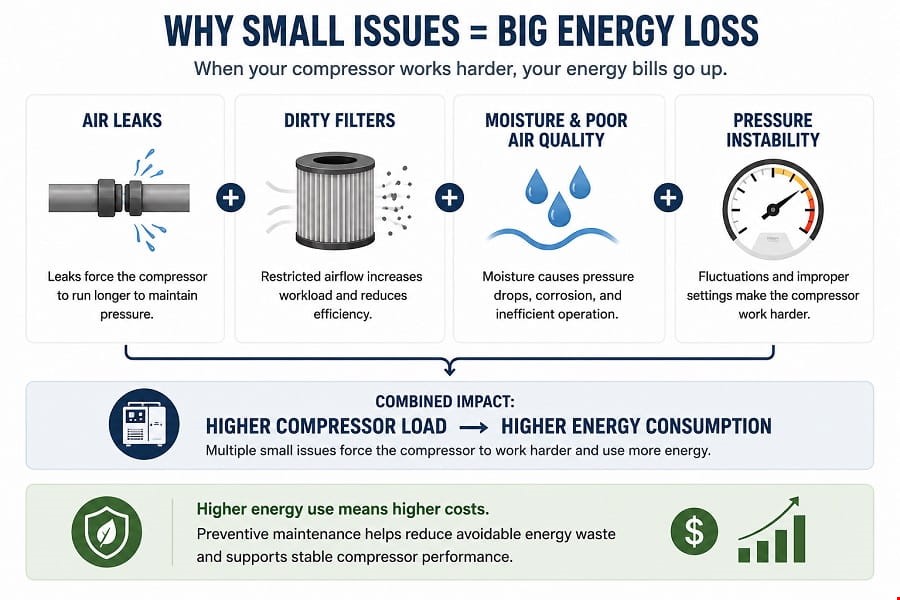
Common maintenance-related causes of energy waste include:
- Dirty intake filters
- Undetected compressed air leaks
- Pressure settings that drift over time
- Poor dryer performance
- Moisture or oil carryover
- Worn valves or internal components
- Frequent cycling due to unstable demand or leaks
If energy consumption rises without a clear increase in air demand, the compressed air system should be inspected for leaks, pressure instability, filtration issues, and air treatment performance.
When Should Compressor Components Be Replaced?
Component replacement should be based on condition, operating history, manufacturer guidance, and system performance. Replacing components too late can create more damage than replacing them proactively.
Filters
Replace filters when contamination persists, airflow is restricted, or pressure drop increases. Dirty filters can increase compressor load and reduce efficiency.
Belts
Replace belts when cracking, fraying, slipping, glazing, uneven wear, or frequent retensioning appears. A belt that repeatedly needs adjustment is usually signaling a deeper mechanical issue.
Oil Separators
Oil separators should be evaluated when oil carryover appears, pressure drop increases, or oil consumption becomes abnormal.
Dryer Components
Dryer components should be serviced when moisture levels rise consistently, dew point becomes unstable, or water appears downstream.
Valves and Internal Components
Valves and internal components require professional evaluation when pressure response becomes unstable, faults recur, or performance declines despite routine maintenance.
Maintenance Kits
For routine service, maintenance kits can help ensure that the correct consumable components are replaced together and at the right interval. These kits are especially useful for facilities that operate multiple compressor models or want to standardize preventive maintenance procedures across sites.
Maintenance kits should still be used according to the compressor manufacturer’s requirements and the actual operating conditions of the facility.
When Preventive Maintenance Is Not Enough
Preventive maintenance is designed to reduce risk, but it cannot solve every compressor problem. Some symptoms indicate that the system needs deeper inspection or technical service.
Professional inspection is recommended when:
- Pressure instability repeats after basic checks
- Moisture or oil contamination persists
- Fault codes reset but return
- Energy consumption rises without increased demand
- Compressor performance declines despite routine maintenance
- Abnormal vibration or noise continues
- Internal wear is suspected
These symptoms often point to internal inefficiencies, control issues, air treatment problems, or component degradation.
Preventive Maintenance vs Predictive Maintenance
Preventive maintenance follows a planned schedule. It is based on recurring checks, service intervals, and known maintenance tasks.Predictive maintenance uses condition monitoring, operating data, and trend analysis to predict when service is needed. This may include vibration analysis, temperature monitoring, pressure trends, dew point monitoring, energy data, and fault history.
For many facilities, preventive maintenance is the foundation. Predictive maintenance becomes valuable when:
- Compressor systems are critical to production
- Downtime is costly
- Load patterns change frequently
- Energy efficiency is a priority
- Multiple compressors operate as part of a larger system
The two approaches can work together. Preventive maintenance provides structure, while predictive maintenance adds data-driven decision-making.
Common Preventive Maintenance Mistakes
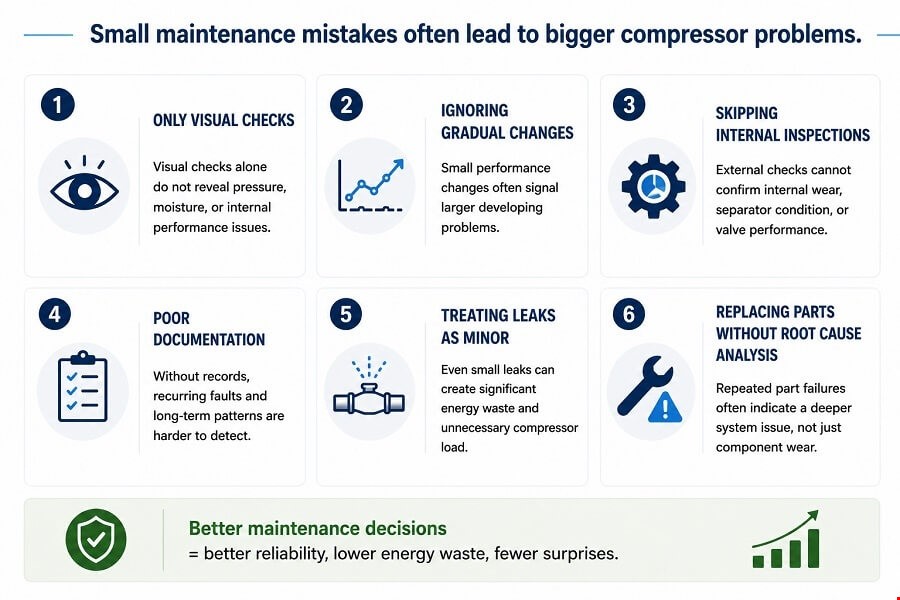
Even when facilities perform routine checks, several mistakes can reduce the effectiveness of the maintenance program.
Relying Only on Visual Checks
Visual inspection is important, but it cannot detect every issue. Pressure behavior, moisture levels, oil condition, temperature trends, and recurring alarms must also be reviewed.
Ignoring Gradual Performance Changes
Many compressor problems develop slowly. A small pressure change, slight increase in operating temperature, occasional moisture issue, or repeated filter contamination may be an early warning sign.
Skipping Internal Inspections
External checks cannot confirm the condition of internal components. Oil separators, valves, bearings, controls, and internal wear patterns require deeper inspection.
Poor Documentation
Without maintenance logs, it is difficult to identify patterns. Documentation helps teams understand whether a problem is new, recurring, or gradually worsening.
Treating Leaks as Minor Issues
Compressed air leaks often seem small, but they can create ongoing energy waste and force the compressor to work harder.
Replacing Parts Without Understanding the Root Cause
Replacing a filter, belt, or drain component may solve the immediate symptom, but recurring problems often point to a deeper issue. If the same part fails repeatedly, the operating conditions should be reviewed.
Final Thoughts
Preventive maintenance for industrial air compressors is most effective when it is structured, practical, and consistent. The goal is not only to complete routine checks, but to understand what those checks reveal about system health.
A strong maintenance routine helps facility teams detect early warning signs, reduce downtime risk, maintain air quality, improve energy efficiency, and protect compressor performance over time. When combined with clear escalation points and periodic professional inspection, preventive maintenance becomes a practical reliability strategy rather than a simple checklist.
If recurring warning signs appear during routine checks, a professional preventive maintenance inspection can help identify the root cause before it develops into downtime.
Learn about EL-AV’s professional air compressor maintenance services >>
Frequently Asked Questions About Industrial Air Compressor Preventive Maintenance
Can preventive maintenance be performed entirely in-house?
Basic preventive maintenance can often be performed by trained facility personnel. This includes visual inspection, oil level checks, condensate drainage, filter checks, and basic leak awareness. Internal inspections, control validation, separator evaluation, and complex diagnostics require appropriate technical expertise.
What happens if preventive maintenance is skipped?
Skipping preventive maintenance increases the risk of reduced efficiency, accelerated wear, air quality problems, moisture issues, pressure instability, and unexpected downtime. Problems that begin as small performance changes can eventually become costly failures.
How do I know if my compressor needs more frequent maintenance?
Maintenance frequency should be reviewed when operating hours increase, environmental conditions worsen, load patterns change, moisture appears downstream, filters clog faster than expected, or pressure instability becomes more frequent.
What are the most important daily compressor checks?
The most important daily checks are visual inspection, oil level and condition, condensate drainage, abnormal noise, vibration, and warning indicators. These checks help identify early problems before they affect production.
Why is moisture control important in compressed air systems?
Moisture can damage pneumatic equipment, increase corrosion, affect product quality, and reduce system reliability. Persistent moisture downstream usually indicates a dryer, drain, filtration, or system design issue.
When should a professional inspection be scheduled?
A professional inspection should be scheduled when warning signs persist, repeat, or involve internal components, oil carryover, recurring faults, pressure instability, moisture problems, abnormal wear patterns, or unexplained energy increase.
Is an annual maintenance program enough for an industrial air compressor?
An annual maintenance program is important, but it should not replace routine in-house checks. Daily, weekly, and monthly inspections help detect changes between service visits, while professional maintenance provides deeper inspection, component replacement, calibration, and documentation.
How does preventive maintenance improve compressor energy efficiency?
Preventive maintenance helps keep the compressor and nearby system components operating under stable conditions. Clean filters, controlled pressure, dry air, properly functioning drains, and repaired leaks reduce unnecessary load on the compressor and help prevent avoidable energy waste.