Designing an SQF compliant compressed air filtration system requires multi-stage treatment to comply with ISO 8573-1 air purity standards in food contact applications.
An SQF compliant compressed air filtration system requires multi-stage filtration engineered to satisfy ISO 8573-1 air quality standards for food processing environments. To meet Safe Quality Food (SQF) audit criteria, systems supplying direct food contact points must combine bulk liquid separation, high-efficiency coalescing filters, desiccant drying down to a -40°C (-40°F) pressure dew point, active carbon adsorption, and sterile-grade micro-filters at the point of use to prevent physical, chemical, and microbiological contamination.
Food and beverage quality assurance managers must demonstrate that compressed air used in processing, packaging, and sorting lines does not introduce hazards into the final product. Navigating the Safe Quality Food (SQF) Food Safety Code requires aligning system engineering with stringent pneumatic design practices.
Understanding SQF Air Purity Mandates for Direct and Indirect Contact
The SQF Code explicitly mandates that compressed air and other gases used in manufacturing and processing must be clean and present no risk to food safety. Auditors categorize compressed air exposure into two primary risk profiles: direct food contact and indirect food contact.
- Direct Food Contact: Compressed air comes into direct contact with food ingredients, finished products, or primary packaging surfaces (e.g., blow-molding bottles, pneumatic conveying of powders, air knives for drying produce, or clean-in-place blowouts).
- Indirect Food Contact: Compressed air exhausts into the ambient processing environment near open product lines, actuation of pneumatic valves over open conveyors, or pneumatics operating within cleanroom boundaries.
To eliminate ambiguity during an SQF audit, facility designers map these contact categories to the international ISO 8573-1:2010 quality classes. Operating certified oil-free compressors provides an effective primary defense against hydrocarbon contamination at the source, but point-of-use purification remains critical.
| Air Application |
ISO 8573-1 Particle Class |
ISO 8573-1 Water Class |
ISO 8573-1 Oil Class |
Target Microorganisms |
| Direct Food Contact |
Class 1 (≤ 20,000 particles/m³ at 0.1–0.5 µm) |
Class 2 (≤ -40°C / -40°F PDP) |
Class 1 or Class 0 (≤ 0.01 mg/m³) |
0 CFU (Sterile air filtration required) |
| Indirect Food Contact |
Class 2 (≤ 400,000 particles/m³ at 0.1–0.5 µm) |
Class 4 (≤ +3°C / +37°F PDP) |
Class 2 (≤ 0.1 mg/m³) |
Controlled via routine environmental monitoring |
Designing Multi-Stage Point-of-Use Filtration Cascades
Achieving direct contact compliance requires a robust compressed air treatment strategy. Installing a single filter at the compressor discharge is never sufficient for SQF compliance due to pipe scale, condensation, and microbial growth that can occur within downstream header lines. Facilities must implement point-of-use filtration cascades directly before the pneumatic drop enters the production equipment.
A compliant multi-stage filtration cascade consists of five sequential treatment phases:
- Bulk Liquid Separation: A high-efficiency cyclone water separator removes bulk water condensate and oil aerosols before they reach fine particulate elements.
- Coalescing Particulate Pre-Filtration: High-efficiency high-efficiency line filters capture solid particulates down to 1 micron and reduce oil aerosol concentrations.
- High-Efficiency Coalescing Micro-Filtration: A secondary coalescer traps sub-micron oil aerosols down to 0.01 mg/m³ and particulates down to 0.01 micron.
- Desiccant Drying & Vapor Adsorption: Twin-tower desiccant air dryers lower the pressure dew point to -40°C (-40°F) to inhibit bacterial growth, followed by an activated carbon adsorber stage to remove oil vapor, odor, and organic compounds.
- Point-of-Use Sterile Air Filtration: A final 0.2-micron absolute-rated sterile filter housing equipped with hydrophobic PTFE membrane elements traps viable microorganisms right at the application point.
The high-efficiency line filters shown below are specifically designed to be configured into multi-stage cascades to meet strict ISO purity requirements.
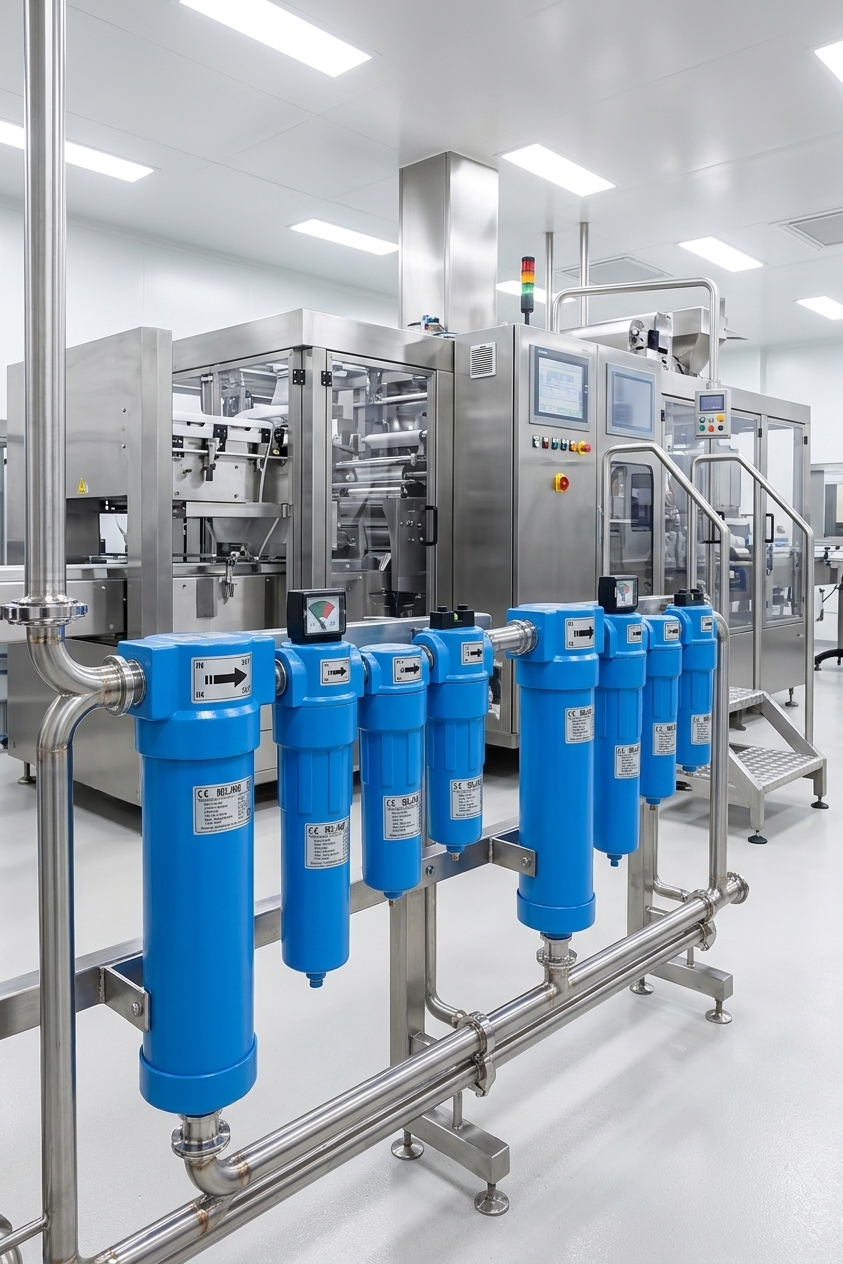 EL-AV EF Series Inline Filters
Selecting Hygienic, Cleanable Pneumatic Components and Stainless Steel Piping
Proper filtration design can be undermined if downstream piping and pneumatic control components harbor moisture, scale, or bacterial harborages. SQF audits evaluate the entire pneumatic flow path for sanitary engineering principles.
Distribution Piping Materials
Black iron and galvanized steel piping are unsuitable for SQF-compliant food production facilities. Black iron generates rust scale, while galvanized coating degrades over time due to moisture exposure. Ideal distribution piping materials include:
- Stainless Steel (304L or 316L): The gold standard for food processing facilities. Smooth internal surfaces prevent bacterial adhesion, resist corrosion, and withstand steam sterilization or harsh washdown chemicals.
- Anodized Smooth-Bore Aluminum: Suitable for main distribution headers up to the point-of-use drop, offering corrosion resistance and leak-free performance without flaking.
Hygienic Pneumatic Components
Pneumatic valves, manifolds, cylinders, and air preparation units installed directly over or adjacent to food zones must meet hygienic design standards. Key design specifications include:
- IP69K Washdown Rating: Solenoid valve manifolds and sensors must withstand high-pressure, high-temperature washdowns (up to 100 bar at 80°C) without moisture ingress.
- Non-Porous, Smooth Enclosures: Smooth body contours eliminate crevices, blind pockets, and sharp internal corners where food particles or moisture can pool.
- NSF-H1 Food-Grade Lubricants: All pneumatic actuators and control valves used in proximity to product lines must utilize certified NSF-H1 food-grade greases to prevent chemical contamination in the event of an internal seal failure.
- Exhaust Air Ducting: Exhaust ports on pneumatic control valves in direct contact zones must be ducted away from open product streams or fitted with cleanroom-rated silencer filters to prevent oil mist or particulate discharge onto food surfaces.
Establishing Routine Air Quality Auditing and Filter Maintenance Protocols
SQF compliance is not a static installation state; it requires documented proof of ongoing verification and preventative maintenance. SQF Section 11.5.5 specifically calls for scheduled monitoring and testing of compressed air quality.
Differential Pressure Monitoring and Automated Draining
Every filter housing in the point-of-use cascade should feature a differential pressure gauge or digital sensor tied into the facility management system. A sudden drop or spike in differential pressure signals element failure or saturation, prompting immediate corrective action before product contamination occurs.
An essential component for preventing condensate accumulation is the zero-loss condensate drain valve shown below, which eliminates standing liquid without wasting compressed air.
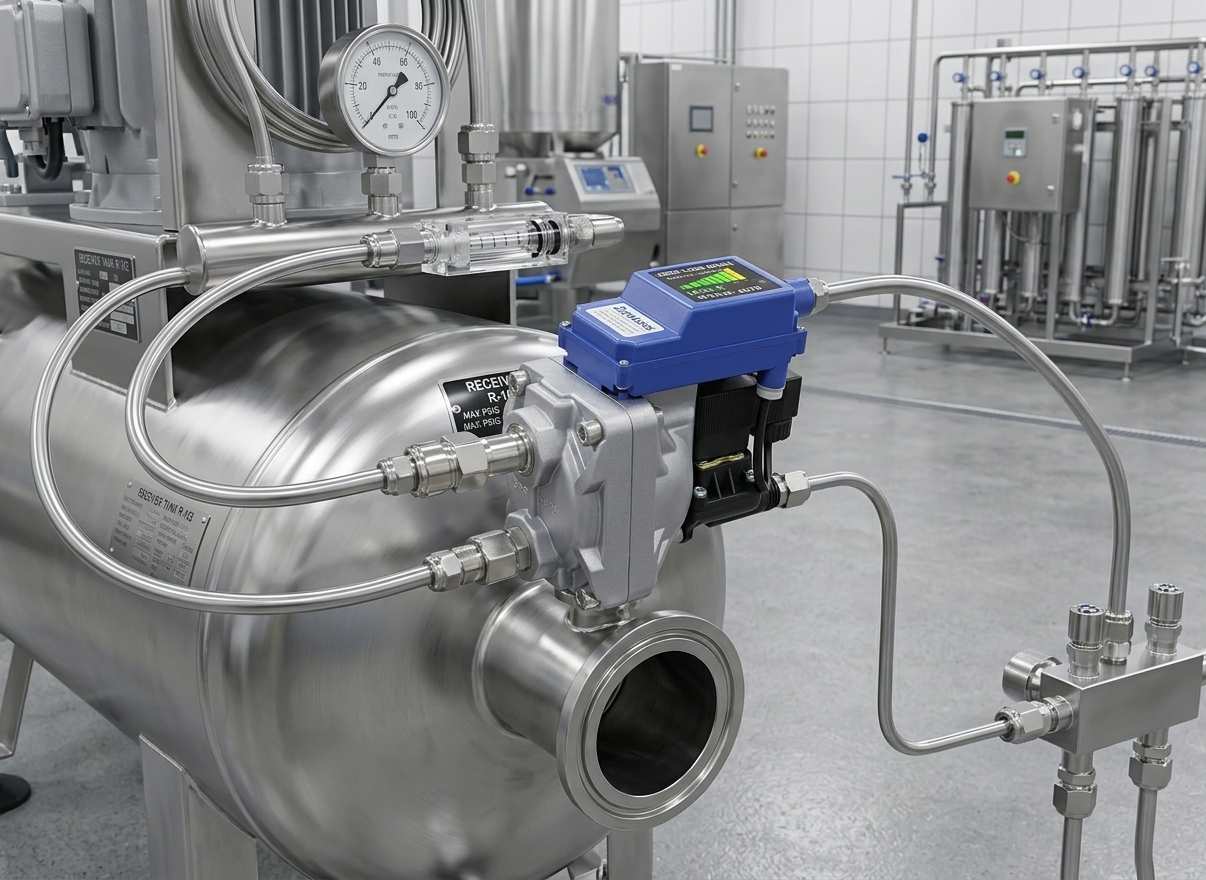 Smart electronic ZeroLoss Drainer
Reliable condensate removal is vital. Installing a reliable zero-loss condensate drain valve beneath moisture separators and receiver tanks ensures condensate is evacuated rapidly without discharging untreated air or suffering mechanical lockup.
Preventative Element Replacement Schedule
Filter elements must be replaced on a strict, documented timetable rather than waiting for failure:
- Coalescing and Particulate Filters: Replace every 6 to 12 months, or when differential pressure reaches 0.35 bar (5 psi).
- Activated Carbon Elements: Replace every 3 to 6 months depending on operating hours, as vapor saturation cannot be measured via differential pressure.
- Sterile Filter Cartridges: Integrity test periodically (using bubble point or pressure decay tests) and replace based on cycle counts or manufacturer validation limits.
Validation and Microbial Air Testing
To satisfy SQF auditors, facilities must institute a routine air testing program. Air quality sampling should be performed at least annually, or following any major system maintenance, utilizing:
- ISO 8573-2 & 8573-5 Testing: Sizing and counting aerosol particulates and vapor concentrations using laser particle counters and chemical indicator tubes.
- ISO 8573-7 Microbial Testing: Impaction air samplers exposing agar plates to compressed air streams at direct contact points. Plates are incubated to verify the absence of colony-forming units (CFU).
Partnering with experienced compressed air specialists for regular scheduled air compressor maintenance ensures that filtration hardware, dryer desiccant, and control systems operate at peak efficiency and maintain audit-ready performance year-round.
FAQ
What ISO 8573-1 air purity class is required for direct food contact under SQF?
Centralized dryers and discharge filters do not protect against pipe scale, condensation, micro-leaks, or bacterial growth that can develop within facility distribution piping before reaching the point of use.
How often should compressed air quality be tested for SQF audits?
SQF guidelines recommend routine air testing at least annually, or immediately following significant maintenance, piping modifications, or system overhauls.
Why are non-lubricated or oil-free compressors recommended for food processing?
Oil-free compressors eliminate liquid oil and oil aerosol contamination at the source, significantly reducing the risk of chemical contamination in the food product stream.